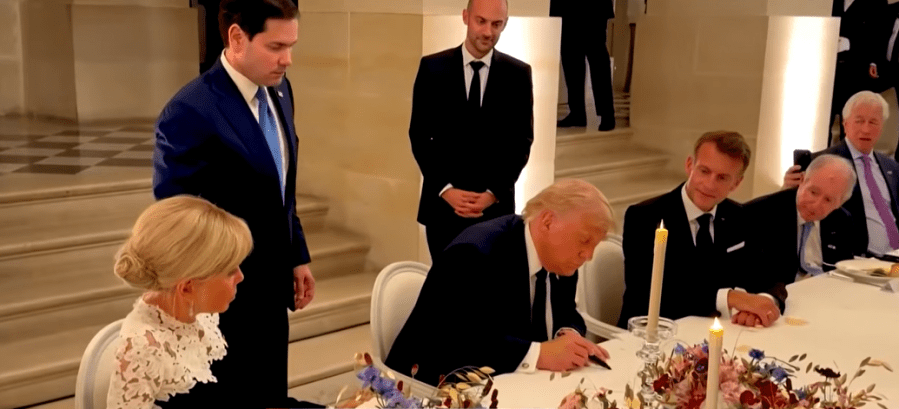
President Trump signed the MOU yesterday in Versailles, France, and details of the document were released. If reports are accurate, it confirms our worst suspicions. Despite right-wing media heaping sappy praise upon the deal, it is difficult to see any benefits gained through the MOU. As so aptly stated: “Washington just handed Iran the keys, the title deed, and the cash from the safe before Iran’s check has even cleared.” (Amir Tsarfati Telegram, 6/17/2026) Here are key details as reported by several media sources:
- Immediate and permanent ceasefire in all theaters, including Lebanon. Not only does this provision make it very difficult for the US to “snapback” military deterrence if Iran misbehaves, but Israel has already declared they are not part of the agreement and will continue defending themselves (including retaliatory strikes against Hezbollah). Israel must do what they need to do to defend their homeland and their citizens. Thus, they will be blamed for disrupting the agreement. President Trump’s negotiating team is fully responsible for putting Israel in that predicament. Disadvantage: Israel.
- Negotiation of a final agreement within 60 days (extendable by mutual consent). First, if extendable, then expect the negotiations to last indefinitely. Iran has mastered the strategy of buying time to reconstitute and restart their weapon manufacturing program. Secondly, it would be political suicide for Trump to retaliate against a misbehaving Iranian regime just before the election. This is a ploy by both sides to delay. Advantage: Iran.
- Lifting of US naval blockade within 30 days. Though President Trump has spouted off about “dropping bombs on their heads” if Iran doesn’t comply, it takes months and billions of dollars to move appropriate forces back into the theater to do so. In essence, there is only a very slim chance the US will do what is necessary to put military pressure on Iran. Advantage: Iran.
- Restoration and protection of commercial shipping routes in consultation with Oman on governance and maritime arrangements in the Strait of Hormuz. That leaves no deterrence of Iran’s ambition to charge fees on passing ships. That is potentially a financial boon to Iran, and we all know where that money will go. Advantage: Iran.
- A joint economic reconstruction plan of a reported $300 billion to be developed. Even though Trump has clearly stated recently that Iran does not get a dime unless they play nicely in the sandbox, the agreement seems to state otherwise. True, those funds may not come from America, but that might be the price Iran’s neighbors pay to keep Iran from firing at them. Again, we all know the only “reconstruction” done with those funds will almost assuredly be for rebuilding their ballistic missile array and restarting their nuclear production facilities. Advantage: Iran.
- Full removal of all sanctions (UN, IAEA, US, etc) under an agreed timeline. Supposedly, Iran will have to earn the removal of those sanctions. However, they will immediately receive “waivers” for their oil industry so they can begin providing oil to China and other adversarial nations. What did they do to “earn” that? They made a pinky promise not to rebuild their nuclear facilities! Also, Iranian assets will be unfrozen and full access given right away. Advantage: Iran.
- Status quo maintained until final agreement: no new sanctions or military escalation. Thus, it seems the US would have to break this provision if military action was necessary to contain Iranian mischief. Advantage: Iran.
- Final agreement must be approved by the UN Security Council. The same UN who has sanctioned Israel more than all other countries combined every year for many years. If there would be anything in that final agreement favorable to Israel it would almost assuredly be scrutinize and removed, if possible, by the UN. Disadvantage: Israel.
- Iran reaffirms it will not develop nuclear weapons and enriched material, and enrichment issues are to be handled under IAEA supervision. As a savvy Mideastern social media influencer said: “There are only two people on planet earth who trust Iran: President Trump and VP Vance.” That says it all. No one believes Iran will abide by that “reaffirmation,” and the IAEA has failed to monitor successfully since the Obama JCPOA. Why do we think they will succeed now? It is also extremely doubtful Trump will follow through on holding Iran’s feet to the fire. After all, in this high-stakes poker game, Iran now holds all the cards.
Once more, I pray every day that President Trump will prove all of us wrong who hold doubts about this deal. Furthermore, I pray fervently that President Trump will reverse course regarding Israel and return to being the most pro-Israel US President ever. However, based on our President’s very own words, it leaves little room for hope that America has not turned its back on Israel. Woe to us as a nation.
Yesterday’s Middle East Update with Amir Tsarfati and Pastor Barry Stagner included many comparisons of Trump statements from the past vs now. If you are interested in those comparisons, here is the update:
Friends, our world is in a tailspin, but regardless, our God is still very much in control and moving mightily in the land of Israel and elsewhere. Now that we know what the MOU contains and how disastrous it is, we must be reminded of God’s faithfulness both to His uniquely called nation (Israel) and to us (believers in Jesus), despite the apparent disaster of a deal. It is a reminder to be more intent than ever to look to God and His Word as our anchor. So, tomorrow we switch focus back to the work of God in Israel and in the lives of believers.
Something is stirring in Israel, and you need to know what it is! See you back here tomorrow!

