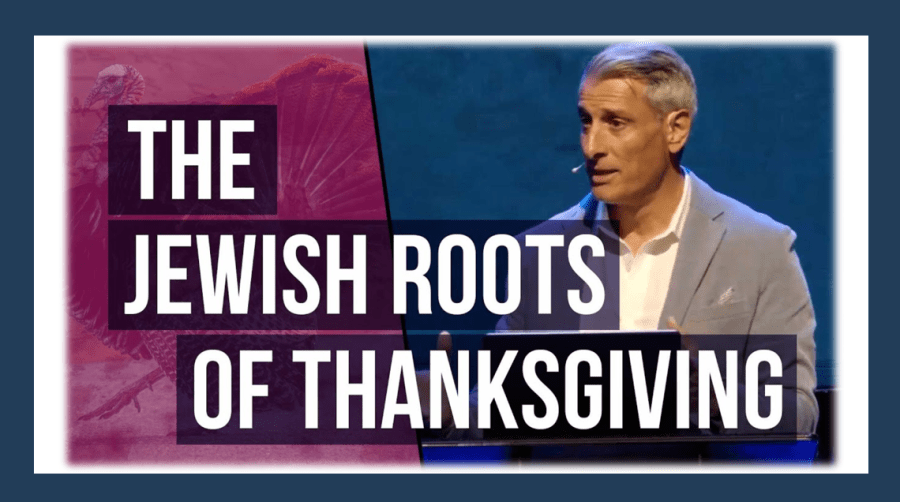
Here in America, we are approaching Thanksgiving. As school children, we were taught of the first Thanksgiving in which new settlers to America rejoiced with Native American Indians in recognition of God’s goodness and abundant supply. The same God they worshipped on that day has remained faithful to us throughout the course of our history. We are wise to genuinely give thanksgiving and praise to our God and King, Jesus Christ, every day, but especially on the special day set aside for it. That is Thanksgiving.
I recently heard a message delivered a few years ago by One for Israel’s president, Dr Erez Soref, regarding hints of Judaism found in our Thanksgiving tradition. I’m summarizing that message below, but you can hear it for yourself here.
Dr Soref reminded us that, as believers in Jesus, we have plenty to be thankful for: our sins are forgiven, our past is redeemed, and our future is secure. If nothing more, that would be enough! Yet, there is much more! We will never run short of reasons to give thanks!
Have you ever thought of the parallels between our pilgrims’ experience and that of the Israelites? As citizens of a tyrannical kingship in England, the pilgrims wandered in a spiritually dry and thirsty land, yearning for the freedom and opportunity to worship as they desired. The Israelites wandered in the wilderness, seeking after God as well. Both pilgrims and Israelites were escaping tyrants (a king and a pharaoh) and heading to a Promised Land. The Israelites crossed the Red Sea to get to their destination. The pilgrims crossed the Atlantic. Both gave thanks after arriving in their Promised Lands.
Leviticus 23 lays out 7 appointed feasts the Lord ordained for the wandering Jewish people. Interestingly, the Hebrew word for “appoint” means with purpose. The appointed feasts were days of specific purpose, and together, they present God’s plan of salvation. The last of the 7 feasts (Feast of Tabernacles) is a time of fellowship, rejoicing and worship before the Savior Himself! And it includes giving thanks.
Dr Soref then identified three reasons to celebrate Thanksgiving:
- To remember. Leviticus 23:39-43 speaks clearly of a season of rejoicing in which fruits of the land were gathered to remember how good God has been. The Thanksgiving feast and the Feast of Tabernacles are reminders of God’s abundant goodness.
- To reflect God’s goodness. Deuteronomy 16:13-15 reminded the Israelites (and reminds us) to rejoice. In our rejoicing, we reflect God’s goodness. Luke 6 reminds us that the reflection of God’s goodness is to stretch even to the unlovable. Thanksgiving should drive us to that sort of reflection.
- To go back to God’s Word. In Deuteronomy 31:10-13 the Lord’s exhortation to His people was to read the law before everyone, that they may hear and learn to fear the Lord and obey His commands. That exhortation extends to you and me, and our refocus on the Word will express itself in exhortation to others.
There is prophetic purpose to the Feast of Tabernacles that we do well to remember as we celebrate this Thanksgiving. According to Zechariah 14:16, a time will come when all nations go up to Jerusalem year after year to worship and keep the feast. As God is fulfilling His plan for all mankind, be reminded of the gigantic Thanksgiving celebration that will take place when we all gather in the Millennial Kingdom at the Feast of Tabernacles!
This Thanksgiving, why not look back and thank God for His grace, love, and mercy, and recalibrate your heart. Thank God in the present and refocus on His Word. Be part of His great plan. Look ahead to the future with great anticipation of the Messiah’s coming! We are His ambassadors sent here to speak on behalf of our King!
I pray God’s blessing upon you as you prepare for this Thanksgiving. May you and your family rejoice with our Lord and Savior as you give Him all thanks!
 Looking for the Blessed Hope
Very interesting read. Thank you for sharing. Thanksgiving has interesting connections to Jewish traditions. Here are a few more key points if you don’t mind me adding to your beautifully written piece.
1. Sukkot Influence: Some historians believe that the Jewish festival of Sukkot, a harvest festival, may have inspired the American Thanksgiving. The Pilgrims, many of whom were Puritans with a strong connection to biblical traditions, might have modeled Thanksgiving after Sukkot.
2. Gratitude and Harvest: Both Thanksgiving and Sukkot celebrate the bounty of the harvest and express gratitude for the year’s blessings. In Judaism, the mitzvah of bikkurim (bringing the first fruits to the Temple) is a similar expression of thankfulness for the harvest.
3. Puritan Roots: The Pilgrims who celebrated the first Thanksgiving were Puritans, a branch of Protestantism that identified closely with the Israelites’ historical traditions and customs. This connection to biblical traditions helped shape the early Thanksgiving celebrations.
4. Modern Observance: Many American Jews embrace Thanksgiving as a secular holiday, focusing on gratitude and family gatherings, much like the Jewish value of hakarat hatov (recognizing the good).
It’s fascinating to see how these cultural and religious traditions intertwine. Thank you again for sharing a wonderful piece. Happy Thanksgiving.
Thank you for commenting, Michael. You’re absolutely right…Sukkot (Hebrew) is also known as the Feast of Tabernacles (English), which was referenced in this post. Thanksgiving certainly seems to have similar characteristics to Sukkot/Feast of Tabernacles. Though not this year, sometimes Sukkot and Thanksgiving occur simultaneously, which makes it fun for those of us aware of the shared characteristics! Blessings to you this Thanksgiving!