
“If we wish to live and to bequeath life to our offspring, if we believe that we are to pave the way to the future, then we must first of all not forget.”
~Professor Ben Zion Dinur, Yad Vashem, 1956
Happy Lord’s Day, my friends! I’m glad you’re here and I hope you are blessed. Beginning today, and over the next few days leading up to the International Holocaust Remembrance Day (January 27), I want to share a very tiny bit about the Holocaust and Antisemitism. It is important for us as believers to have a right relationship to the Jewish people, and understanding their history helps.
On November 1, 2005, the United Nations General Assembly designated January 27 as the annual International Holocaust Remembrance Day. Why January 27? Because the liberation of Auschwitz-Birkenau, the largest Nazi death camp, was liberated on January 27, 1945. However, while January 27 is recognized internationally as the day of remembrance, Israel commemorates Yom Hashoah Ve-Hagevurah (Day of the Holocaust and the Heroism) on the 27th of Nisan (April-May) to mark the anniversary of the Warsaw Ghetto uprising. Both days commemorate the same thing.
In Jerusalem today stands Yad Vashem, Israel’s official memorial to the victims of the Holocaust. Established in 1953, Yad Vashem is the world center for documentation, research, education and commemoration of the Holocaust. Yad Vashem means “a memorial and a name,” and is taken from Isaiah 56:5:
I will give them—within the walls of my house—
a memorial and a name
far greater than sons and daughters could give.
For the name I give them is an everlasting one.
It will never disappear!
God has given each a name, and Yad Vashem is the memorial place! Every person in the Holocaust deserves a memorial and a name. Furthermore, it is important to put faces to the Holocaust. If memories of the atrocities remain nothing more than gruesome pictures of dead bodies, then we terribly miss the significance of the life that filled the Jewish people, despite the horrific circumstances in which they endured. So, let’s put some faces to the Holocaust!
I recently had the privilege of traveling to Israel to attend a Christian Leadership Seminar at Yad Vashem. During the course of that seminar, we listened to the stories of Holocaust survivors and I want to share two of them with you.

Born in 1928 in Berlin, Hannah Pick was only 5 when her family fled Nazi Germany for the Netherlands. It was there that she met Anne Frank and they became friends. In 1942, Hannah’s family went into hiding, and it was thought that the Frank’s had fled to Switzerland. However, in 1944, Hannah’s family was transported to Bergen-Belsen, and through unimaginable circumstances, Hannah found out that the Frank’s had not reached safety, but that Anne was actually in a separate part of the same death camp. Anne was executed there. (Read more details about Hannah and Anne Frank here.)
Nearing 90 and at home in Israel, Hannah continues to share her story with Israeli children and other groups, where she says, “The message I try to get across is that things like this should never happen again.”
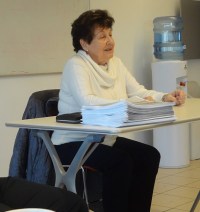
Eva Lavi was the youngest survivor on Schindler’s List. Born in Krakow Poland, Eva and her mother were sent to the Krakow Ghetto when Eva was only 2, and in 1944 they found themselves at Auschwitz. Death was everywhere, yet one day the children were taken to a special room, fed and dressed. Those on Schindler’s List were gathered together and transferred out of Auschwitz to a camp in Czechoslovakia, where Schindler had a factory. To protect Eva, Schindler (who was a Nazi and had connections to the SS) explained to authorities that he had a very specific job that required a child with small fingers. This is the only transport known to have left Auschwitz with living bodies. (Read more about Eva’s experience here and about Oskar Schindler’s heroics here.)
Today, Eva lives in Israel and travels about to share her experiences and educate others about the Holocaust. Her grandchildren are serving in the IDF, for which she holds a special place in her heart.
These are just two faces in the Holocaust who happened to survive. 6 million were not so fortunate, yet they had faces too. It is important to commemorate the people of the Holocaust, rather than the atrocities thereof.
Check back tomorrow as we try to put the Holocaust into context and discover more about what the Holocaust was.
 Looking for the Blessed Hope