
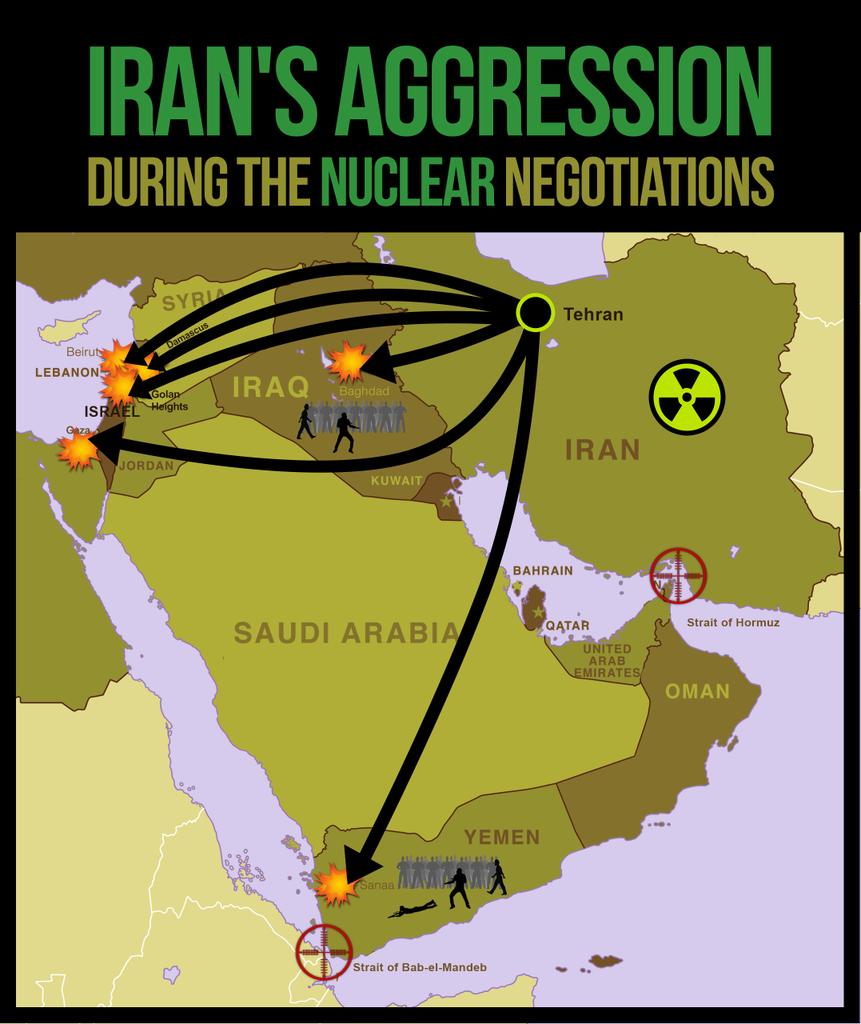
Earlier today, the P5+1 and Iran announced they had reached agreement on a framework deal regarding Iran’s nuclear program. While President Obama touts it as a “good deal” and the “best option” for Israel, Prime Minister Netanyahu’s office was tweeting the diagram above, showing locations of Iranian aggression DURING the nuclear negotiations.
The deal reportedly cuts the number of Iranian centrifuges from 19,000 to about 6,000, requires Iran to allow IAEA inspectors to consistently inspect nuclear facilities, and prohibits Iran from stockpiling enricher uranium. Supposedly, Natanz is the only nuclear facility allowed to continue enrichment (though not to weapons grade). In return, the US and the European Union have agreed to lift sanctions on banking, insurance and oil immediately.
While it may sound good, consider this:
- The deal lasts for only about 10 years, after which Iran will be free to develop nuclear power as it sees fit.
- For years Iran has “agreed” to allow inspectors into facilities, but have either reneged on those “agreements,” or has secretly built new facilities and conducted nuclear research. They have also consistently violated UN resolutions, and are the world’s foremost exporter of terrorism. Have they really gained the trust of the international community?
- The deal does not address Iran’s push for development of intercontinental ballistic missiles (ICBM’s) capable of delivering nuclear warheads.
- If sanctions are lifted immediately, all Iran has to do to gain relief is keep their nuclear nose clean for a few months. After the sanctions are lifted, it will take considerable time to re-instate them…assuming it is even possible.
As recently as December, 2013, Obama said:
“In terms of specifics, we know that they don’t need to have an underground, fortified facility like Fordow in order to have a peaceful nuclear program. They certainly don’t need a heavy-water reactor at Arak in order to have a peaceful nuclear program.”
Yet, Iran was not forced to give them up.
While giving lip service to removing sanctions gradually, dependent upon Iran’s compliance with the agreement, the reality is that Obama has been working to ease sanctions on Iran since the election of Rouhani as president in 2013. Thus, it is no surprise that the agreement includes the immediate lifting of sanctions once Iran complies with initial requirements.
In a conversation today with Netanyahu, Obama acknowledged Iran’s sponsorship of terrorism and threats toward Israel. He said that “there is no daylight when it comes to our support for Israel’s security.” We’ll see what happens when the rubber meets the road. To date, Obama has proven to be anything but a friend of Israel.
The Israeli response was predictable. In the conversation with Obama, and in tweeting the diagram above, Netanyahu expressed concern that Iran has not been asked, much less pressured, to cease aggressive action in the region. Likewise, Naftali Bennett, a potential foreign or defense minister in the new Israeli government, likened the announcement of a framework deal to Neville Chamberlain’s statement following the Munich Conference in 1938: “Peace for our time.” Less than a year later Hitler plowed through Poland, igniting World War II in Europe.
So, was Iran given a free pass? It certainly looks like it in many ways. The deal is not finalized, and won’t be until June 30. Meanwhile, various diplomats throughout the world, as well as much of the US Congress are bristling at the deal. Only time will tell if the deal stands. However, regardless the outcome, our God is still in control! One day evil will be eradicated, but until then, we must trust that no matter what transpires on this earth, our hope is in the Lord!
“The Lord is my portion,” says my soul,
“Therefore I have hope in Him.”
The Lord is good to those who wait for Him,
To the person who seeks Him.
It is good that he waits silently
For the salvation of the Lord.
~Lamentations 3:24-26
 Looking for the Blessed Hope