
Welcome back friends. We have paused during the darkest day in history in order to shed some light on where Jesus was crucified. If you did not take some time to read one of the Gospel accounts of Jesus’ crucifixion before today’s post, I urge you to stop and read one of the accounts now. The life is in The Book (not in this blog), so go ahead….we’ll wait for you! (Matthew 27:33-66, Mark 15:22-47, Luke 23:33-56, John 19:16-42)
Each of the Gospel passages regarding Jesus’ crucifixion indicated where it took place. Did you catch it? If you’re thinking “Golgotha, the Place of the Skull,” we’re thinking alike with Scripture as our guide! (That’s the way we like it!) Now, having read Scripture, let me provide a map of Jerusalem in order for you to put in perspective the area those passages describe.

One thing to be clear about: the walls of Jerusalem today were not the walls of Jesus’ time. In fact, the walls have been in different places throughout history, as they were either expanded by various kings (as Solomon expanded the original Jebusite walls), or were torn down in battle (as when the Babylonians and Romans conquered the city). On the map above, the walls during Jesus’ time are outlined in darker shade than the current walls. Thus, the northwestern 1/4 or so of the yellow-colored area was OUTSIDE the walls during Jesus’ day.
Why is this important? Because John 19:17 says that Jesus “went out” bearing His own cross. Along with other very reliable historical accounts, we know that Jesus was crucified and buried outside the city walls. We also know it was on a very busy roadway, likely the trade route between Egypt and Syria. It was a place called Golgotha…Place of the Skull.
John 19:41 also says, “Now in the place where He was crucified there was a garden, and in the garden a new tomb in which no one had yet been laid.” All four gospels tell us that Joseph of Arimathea, a “prominent (wealthy) member of the Council,” asked for Jesus’ body, anointed it according to Jewish custom, and laid it in his own tomb hewn out of stone.
So here is what we know, according to Scripture and our brief synopsis:
- Crucifixion took place outside the city walls.
- Crucifixion took place on a busy roadway (in view of many mockers).
- Crucifixion happened at Golgotha, the Place of the Skull.
- Crucifixion happened near a garden.
- Jesus was buried in that garden.
- The tomb was hewn from stone.
- The tomb belonged to a rich man.
- The tomb had never been used.
- A large stone was rolled over the entrance.
Now go back up to the map. You will see two different “Calvary’s” (place of Jesus’ crucifixion). That is because many Christians believe the Church of the Holy Sepulcher now sits atop the Calvary of Jesus’ day. This is the “traditional” site of Jesus’ crucifixion. Evangelical Christians (myself included) tend to believe the “Calvary” further north, known as Golgotha and the Garden Tomb, are the true sites of Jesus’ crucifixion and burial. So, let’s put them both to the 9-part test from above:
- Most believe the traditional site was outside the city walls of Jesus’ day, though there is a small amount of debate about that. Not that it really counts, but I believe it was more likely than not outside the city walls. Golgotha and the Garden Tomb are both definitely outside the city walls of Jesus’ day (as well as all subsequent walls). Thus, in my mind, both pass checkpoint #1.
- There very well could have been a roadway (likely to Joppa) near the traditional site. However, it is believed that the main trade route (to Damascus) would have been further north, near where Golgotha and the Garden Tomb lie. In my mind, there is not enough evidence to be dogmatic, but I tend to think it makes more sense that crucifixion took place near the most well-traveled road.
- It is believed that there was a quarry where the Church of the Holy Sepulcher now sits. Thus, it is possible there could have been some skull-like feature on a hill there. However, here is a picture of Golgotha. What does it look like to you?

(BTW – an Arab bus station now operates just in front of this place. Likewise, an Arab cemetery lies on top of it. Many “projects” have been undertaken that have eroded or caused this hill to crumble. It seems much is being done to destroy evidence of Jesus’ crucifixion.)
4. Though it is possible that a garden may have existed at or near the traditional site of Jesus’ crucifixion, Golgotha definitely sits at the edge of a garden. Archeologists have discovered evidence, such as a garden-type water cistern, from around the time of Jesus. Here are pictures of the garden.
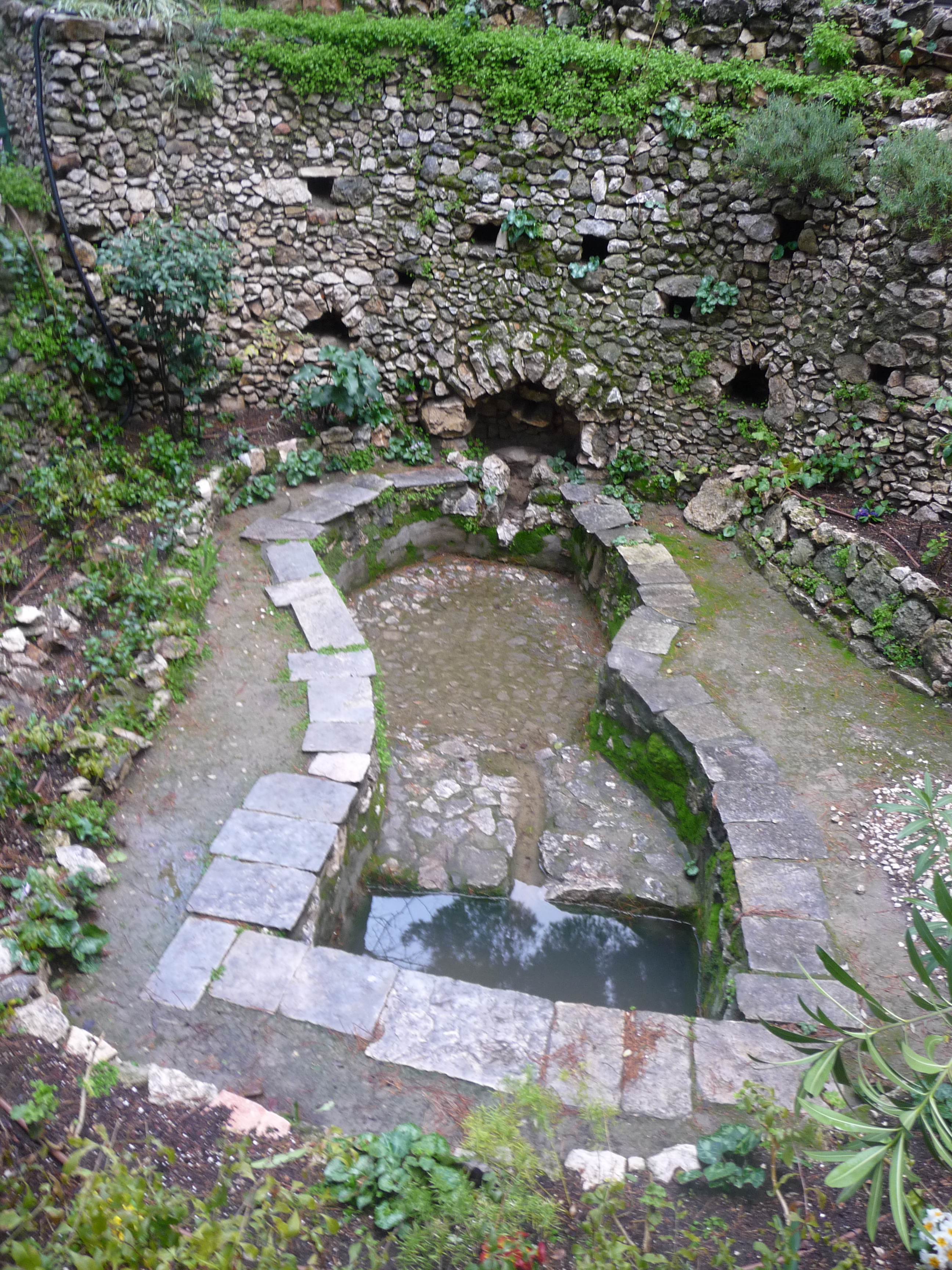

Okay gang, that’s enough for one day! We’ll run through the remaining 5 tests tomorrow to discover where Jesus was really crucified. I hope this gives you some appreciation of the sites in Israel…and I hope the Bible is coming alive to you! Thanks for journeying with me. Come back tomorrow!
 Looking for the Blessed Hope