
We’ve been looking at the darkest day in history….the day of Jesus’ crucifixion. It is important not to lose sight of the truth that Jesus Christ WAS in the beginning!
In the beginning was the Word, and the Word was with God, and the Word was God. He was in the beginning with God. All things came into being through Him, and apart from Him nothing came into being that has come into being. In Him was life, and the life was the Light of men. And the Word became flesh, and dwelt among us, and we saw His glory, glory as of the only begotten from the Father, full of grace and truth. ~John 1:1-4, 14
Jesus Christ was (and still is!) God, yet He came in the flesh to dwell among us. He also came to give His life a sacrifice, so that sinners such as you and me might have eternal life with the Father, Son and Holy Spirit. That is the truth that brings freedom to us sinners!
My prayer is that, today, you will see His glory in a fresh new way as we examine the place where the Sacrificial Lamb of God was laid. Again, I encourage you to stop and read at least one of the Gospel accounts of Jesus’ crucifixion. If you read one yesterday, why not read a different one today! (Matthew 27:33-66, Mark 15:22-47, Luke 23:33-56, John 19:16-42)
There are two conflicting sites recognized by different groups of Christians as the site of Jesus’ death and burial. The “traditional” site, believed by Greek Orthodox, Roman Catholics and others, lies beneath the Church of the Holy Sepulcher inside today’s walls of the Old City. Evangelical Christians tend to view a location further north as the spot of Golgotha and the Garden Tomb. Yesterday, I introduced a 9-point test in determining where the Cross of Calvary was planted, and we covered the first 4 of those tests. (See To Golgotha – Part 1 for a map and to catch up on the first 4 points.) Today we’ll examine the final 4 tests:
6. The tomb was hewn from stone.
7. The tomb belonged to a rich man.
8. The tomb had never been used.
9. A large stone was rolled over the entrance.
(If you noticed that we left out #5, you’re very observant! We’ll come back to it tomorrow!)
- The tomb, by Biblical standards must have been hewn from stone. While the replica of what is said to be the possible tomb of Jesus at the traditional site looks more like a cave, the Garden Tomb is definitely hewn from stone. This is what is presented as a replica of Jesus’ tomb at the traditional site:
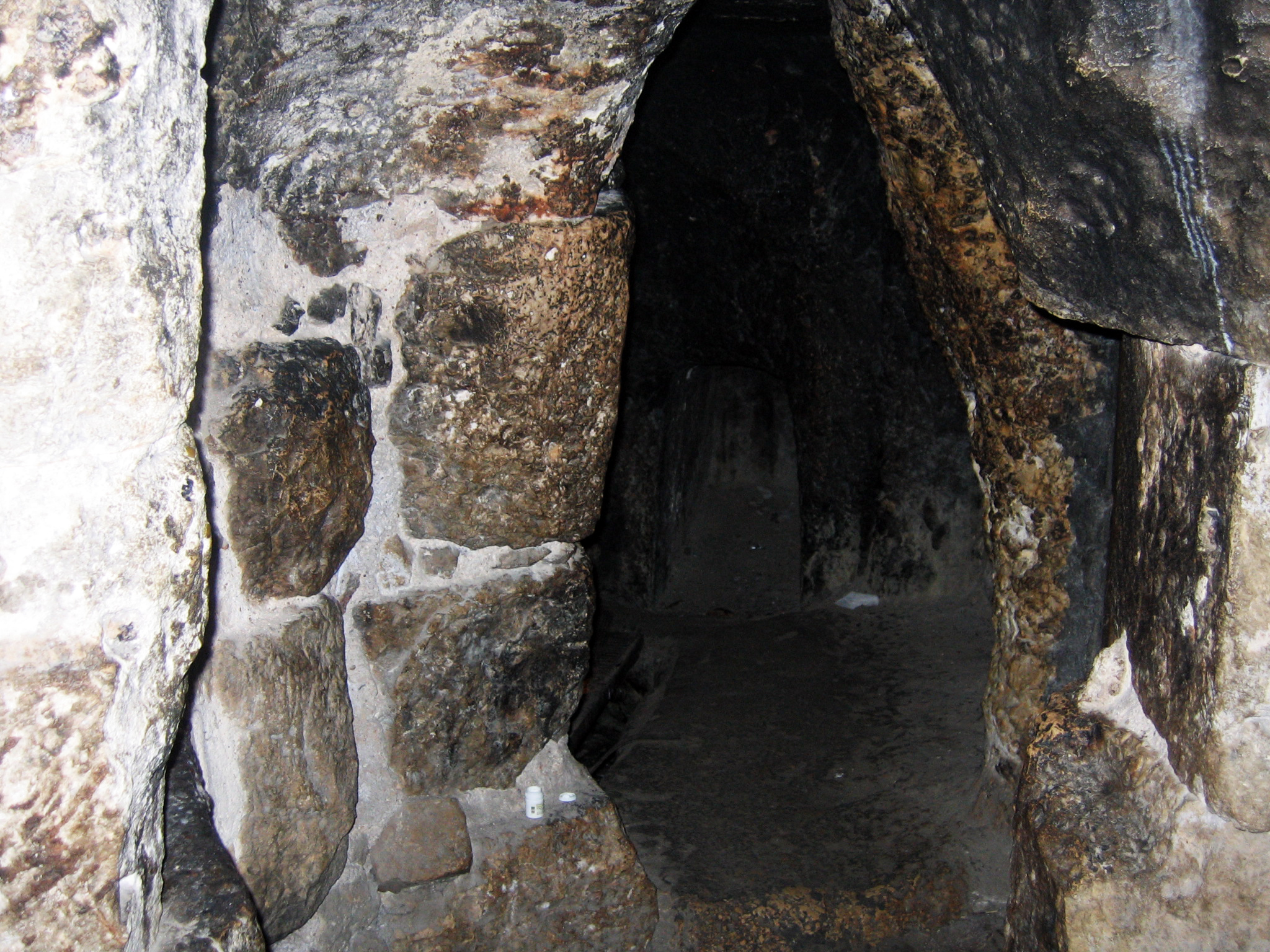
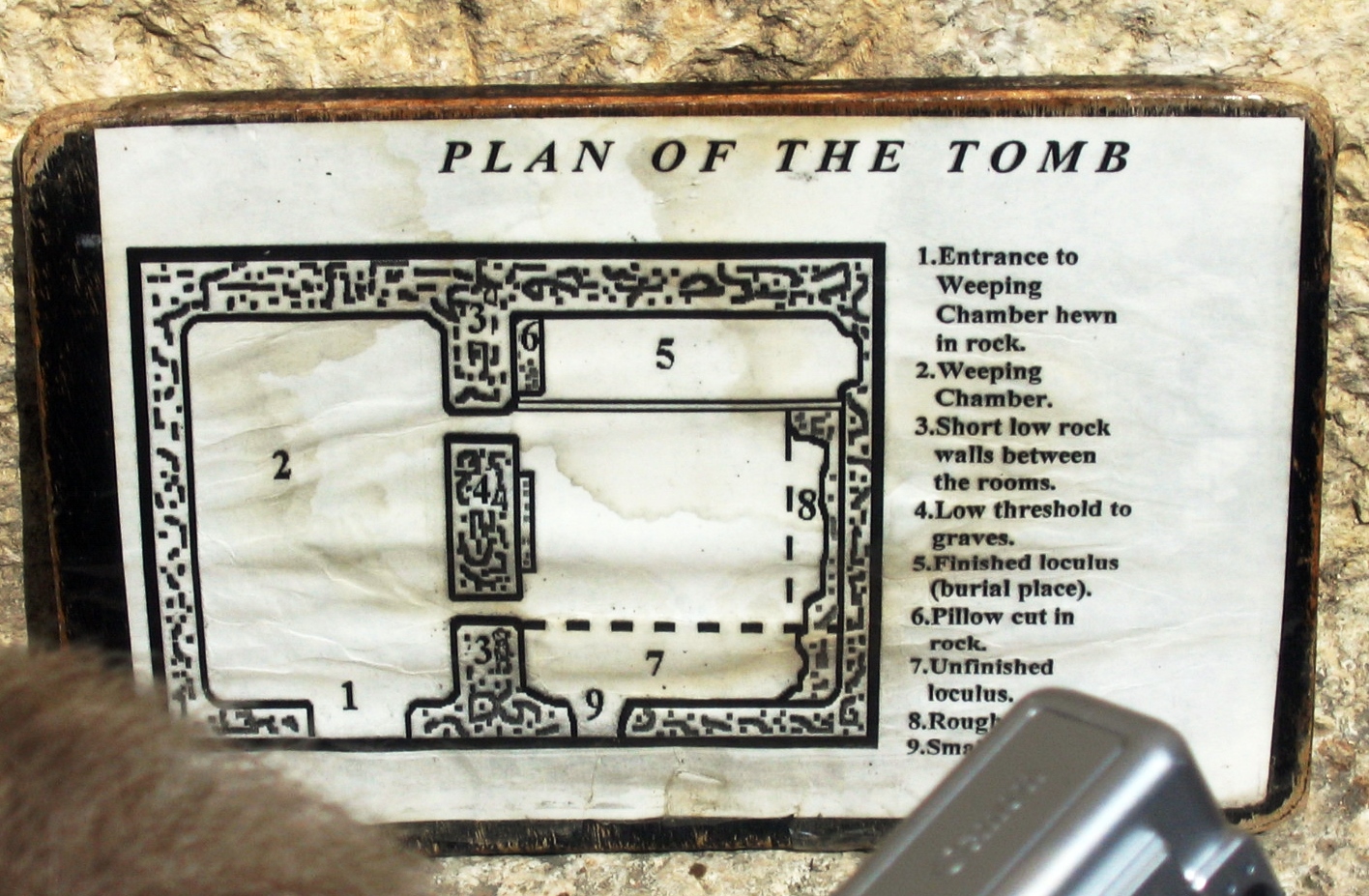
The pictures below are of the Garden Tomb, including one of the actual place in the tomb where Jesus’ body is believed to have been laid. There is also a “design” to the inside of the tomb, as it was prepared for the burial of two people, and included a foyer-type area, known as the weeping chamber. (See the third picture below.)

- Does the tomb at the traditional site look like a rich man’s tomb? It doesn’t to me. Here is a picture of a common tomb from Jesus’ day:

Compare that to the picture of the Garden Tomb above. Does the large, well-designed Garden Tomb appear to be a rich man’s tomb?
- The Bible says the tomb had never been used. Inside the Garden Tomb, there is evidence that it was unfinished before Jesus’ body was laid inside. For example, one of the places for a body to be laid appears to be unfinished. (See #7 in the diagram of the tomb above.) Thus, it was likely that this tomb of Joseph of Arimathea was pressed into service before it was even ready.
- The stone rolled in front of Jesus’ tomb must have been larger than normal, as we know that Roman soldiers could not roll the stone away. The Garden Tomb was also that of a rich man, likely meaning it was far larger than the common tomb. A stone to cover the entrance to the Garden Tomb would have to have been at least 6-7’ tall…much larger than the tombstone rolled in front of the common man’s tomb in the previous picture above. And the door to the alleged “traditional” tomb site would not have been very large either.
So, where was Jesus crucified and buried? It’s certainly not a matter of salvation, so there is no need to be dogmatic. However, the evidence seems to indicate that Golgotha and the Garden Tomb are indeed what Scripture describes as the setting on the darkest day in history.
Tomorrow we’ll look at that fourth and final “test”…which really is no longer a mystery! We’ll hang out in the very Garden where Jesus was indeed laid, and we’ll simply contemplate Jesus’ sacrifice for you and me. See you tomorrow!
 Looking for the Blessed Hope