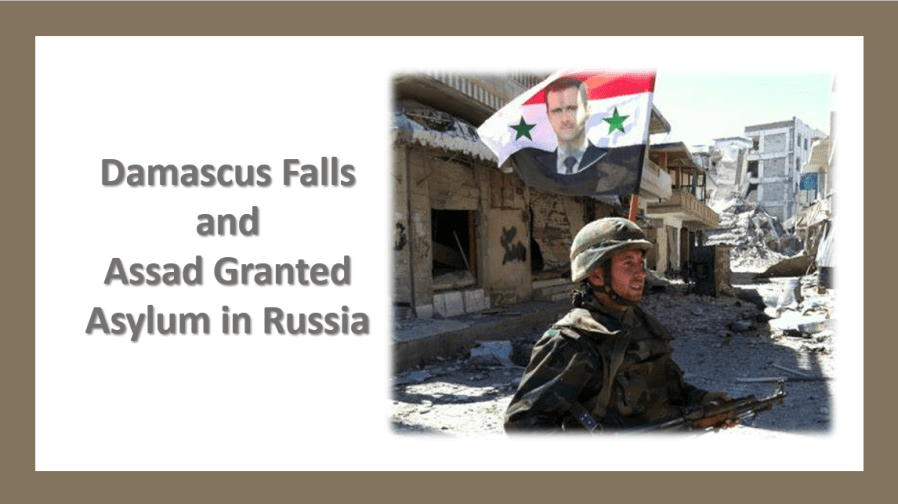
Syria is in disarray. For years the Assad regime held power with the support of Russia and Iran. Though technically still a nation, different factions carved out portions of Syria from which to operate.
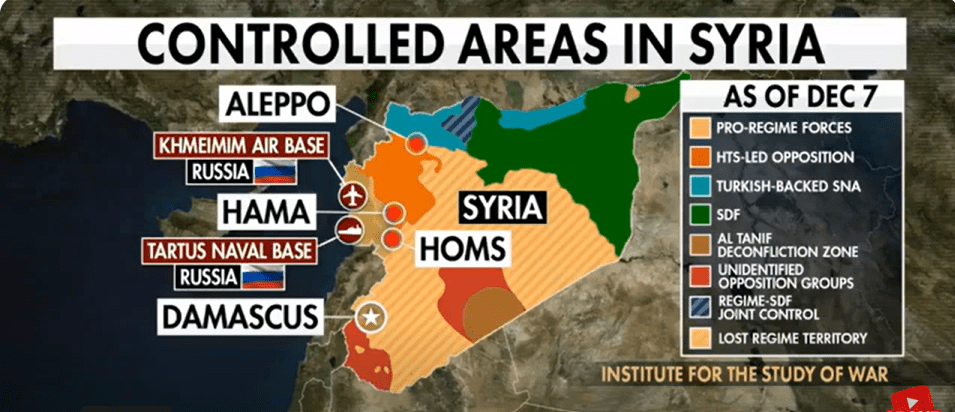
As seen on the “before” map in yesterday’s post, Syria was a collage of Assad loyalists, the Kurds and allied forces, rebels/various terrorist groups, and al-Qaeda/ISIS cells. Assad is now gone and terrorist groups control most of Syria. Here is a look at who controls what as of a couple days ago:
So, what’s next?
First, it is believed Bashar al-Assad and his family have fled to Russia where they reportedly have been granted asylum. Rebel groups, including elements of ISIS and al-Qaeda, successfully overthrew Assad and now lay claim to Syria.
Secondly, Israel sees both a threat and an opportunity. The threat is abandoned sophisticated weapons and air defense systems falling into the hands of rebels. Being just across Israel’s northern border, that presents an existential threat should jihadist rebels get their hands on them.
The opportunity Israel is seizing is due to the void left when Assad’s army fled. Suddenly, those weapons and defense arrays are left unmanned and unprotected. Therefore, Israel is now operating on an incredibly large scale in Syria, destroying weapon storage, manufacturing, and intelligence facilities, as well as tanks and other ground equipment, aircraft of all kinds, and all naval vessels. In short, they are completely destroying Syria’s entire military. That includes Syria’s air defense systems, ensuring the IDF will have unfettered access to take care of business if needed in the future. It is total annihilation, as those operations are said to be more massive in severity and number than any offensive in Israel’s history.
Why is this important? What Israel does right now lays the groundwork for coming years and PM Netanyahu is taking full advantage of the opportunity. Borders and their protection were negotiated with the Assad regime. Now that the regime is gone, border defense is being bolstered and military capabilities from the Syrian side are being completely decimated. This helps ensure safer Israeli borders against Iran, its proxies, and anyone else with ideas of attacking Israel.
Meanwhile, what is America’s response to the aftermath of the Damascus takeover? US forces have made some significant strikes on ISIS camps and other installations in central Syria. US Central Command General Eric Korilla vows not to allow ISIS to gain advantages of the situation in Syria. That seems like a good idea, but there is concern regarding Biden’s official statements seeming to take credit for the overthrow of Assad and indicating possible aid to groups in Syria (including those derived from al-Qaeda and ISIS).
Expect things to change dramatically once the new American administration takes office on January 20, 2025. Even now, President-elect Trump is framing his official response once in office. He has issued a loud and clear message that this is not America’s war and that we should not get involved.
In principle, Trump’s policy makes sense. However, there are questions to be considered. For example:
- To what degree do we defend our interests (oil fields) in the region? (Northern Syria and Iraq) We currently have troops in Syria. What do we do with them? If we pull out, does it put oil fields in a vulnerable position to be taken over by rebels? Those troops are also busy right now taking out ISIS positions that threaten our interests. Do we cease those operations or continue them? (We need clear rationale and a specific exit plan to determine if troops should come out of there. We have neither with the current administration.)
- To what degree do we defend our ally, the Kurds, in the region? The Kurds have been steadfast partners in defending American interests in the region.
- To what degree do we assist Israel in doing what is necessary to “cut off the head of the snake” (Iran)?
It is far too early to project what might happen in the volatile and unpredictable Middle East, and whatever happens will likely be far different than what we might imagine today. However, given Israel’s current dominance, Russia’s attention to the debacle in Ukraine, the collapse of Iran’s proxy network, and the promise of strong American leadership in the near future, could it signal lessening birth pangs?
Perhaps. But never forget…when it comes close to time for the birth of a baby, birth pangs may come and go, but a baby will definitely be born at the appointed time! Birth pangs may subside for a season…and I hope they do. But eventually, Russia, Iran and Turkey will not only regroup, but will coalesce into an invading army.
Friends, there is a lot going on in our world. We are wise to keep our eyes on Israel, and wise to pray that President Trump gives the world a reprieve from the gapping void of world leadership.
 Looking for the Blessed Hope